Breakout Entry vs Pullback Entry: Navigating Risks and Rewards for Smarter Trading

Breakout and pullback entry strategies each have distinct risk profiles, risk/reward ratios, and trading characteristics suited for different trader types. Breakout entries offer the potential for capturing large price moves early but involve higher volatility and risk of false breakouts. Pullback entries tend to provide safer, more precise entry points with tighter stops but may miss the biggest initial moves.
Breakout Entry Strategy: Risk Assessment and Profile
Breakouts occur when price moves beyond established support or resistance levels, typically confirmed by volume surge. They aim to capitalize on momentum and large price movements.
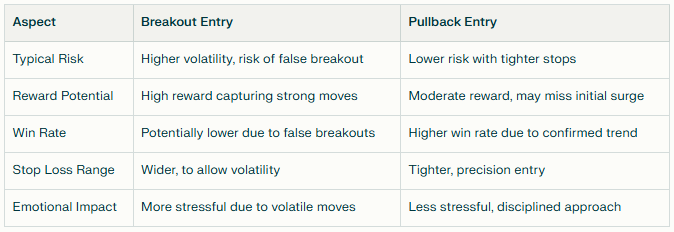
Risk is higher due to possibilities of false breakouts where price quickly reverses. This requires wider stop losses to accommodate volatility.
Risk/reward can be favorable if breakout sustains, capturing strong trending moves and offering potential for substantial profits.
Traders must use strict stop-loss orders and plan targets ahead to manage risk and reduce emotional trading.
Pullback Entry Strategy: Risk Assessment and Profile
Pullbacks are temporary reversals within a trend, offering entry opportunities at better prices after initial moves have started.
Risk is generally lower with tighter stop losses, as the trend direction is more confirmed and pullbacks often respect key support/resistance levels.
Pullbacks usually produce higher win rates due to clearer directional bias but risk missing the initial explosive move of a breakout.
Successful pullback trading requires discipline to avoid chasing and correctly identifying shallow corrections vs reversals.
Risks and Rewards Comparison
Suitable Traders and Investors
Breakout entries suit aggressive traders and momentum traders willing to accept higher volatility and risk for potentially large gains.
Pullback entries are more suitable for conservative traders or those preferring higher probability trades with defined risk and better risk control.
Investors focused on longer-term trends might favor pullbacks for safer entries, while short-term traders might prefer breakouts to catch early momentum.
In essence, breakout trading captures trend initiation with higher risk and reward, while pullback trading offers safer, more controlled engagement with trends but may lag the initial move. The choice depends on individual risk tolerance, trading style, and trend market conditions.
Investors’ Choice of Entry
Investors should generally favor pullback entry strategies over breakout entries. Pullbacks offer safer and more precise entry points by allowing investors to buy during temporary price retracements within an established uptrend, reducing risk with tighter stop losses and higher probability of trend continuation. This approach aligns well with the longer-term, risk-adjusted mindset of most investors who prioritize capital preservation and sustainable growth.
Breakout entries, while potentially capturing early and rapid gains from momentum-driven moves, carry higher risk from false breakouts and greater volatility, which can result in frequent stop-outs. Such risks are more suitable for aggressive traders or those with a higher tolerance for short-term volatility and rapid position management.
In summary, investors seeking steady returns with controlled risk generally benefit more from pullback entries that align with confirmed trends, enabling more disciplined and patient position building over time. Traders with an appetite for higher risk and faster profits may incorporate breakout entries as part of their strategy.