High Float Turnover Trading Manual: Wisdom from Ross Cameron & Steven Dux

1. Core Metrics: Most Crucial Foundations
1.1 Float Turnover Ratio (ADV / Free Float)
Target: 1.0 or higher to ensure the float fully rotates daily.
Role: Key gauge of liquidity and momentum.
Ross & Dux emphasize stocks where volume massively exceeds average, reflecting genuine trade interest.
1.2 Free Float Percentage
Ideal Range: Below 50%, often 5-20% for enhanced volatility.
Importance: Low float increases price sensitivity to volume surges, crucial for momentum moves.
1.3 Average Daily Volume (ADV)
Minimum Threshold: ~400,000 shares, adjustable by price and market cap.
Both traders screen for consistent volume spikes well above normal daily averages, using relative volume (RVOL) filters of 3x to 5x+ to detect surges.
1.4 Market Capitalization
Preferred Range: Focus on micro-cap to small-cap stocks ($50M to $2B).
Smaller caps align with low floats, produce bigger swings, and are the hunting ground for Ross and Dux.
2. Supplementary Key Factors: Enhance Precision
2.1 Relative Volume (RVOL)
Target: Minimum 3x, often 5x or greater.
Indicates a volume spike above usual trading levels, confirming momentum.
2.2 Absolute Free Float Shares
Threshold: Preferred under 20 million shares.
Impacts liquidity and volatility dynamics complementary to float %.
2.3 Stock Price Range
Ideal: Between $2 and $20.
Ross typically trades in this range; affordable for rapid execution and suitable volatility.
Dux avoids micro-penny float (<$1) for excess risk.
2.4 Position Scaling & Risk Management
Both emphasize small, incrementally scaled positions rather than full exposure initially.
Tight stop-losses (e.g., 2:1 or 3:1 risk-reward).
Flexibility to take partial profits and exit on early signs of reversal.
3. Optional but Valuable Factors: Tactical Considerations
3.1 News & Catalysts
Earnings, FDA approvals, partnership announcements trigger volume bursts and provide context.
Ross watches for pre-market catalyst-driven watchlists; Dux integrates fundamental context for trend confirmation.
3.2 Price Action & Order Flow
Use of Level 2 data, Time & Sales for volume clusters and liquidity “pools” before entry.
Micro pullbacks and gap-ups exploited strategically.
3.3 Trading Style
Best suited for active, intraday momentum traders.
Ross focuses on morning momentum and quick scalps.
Dux combines swing and short-term strategies tailored to float dynamics.
4. Common Pitfalls and Redundancies
Ultra-low floats with sub-100k shares can be unpredictable and illiquid.
Stocks with market cap above $2B usually lack float volatility necessary.
Relying only on float % without considering volume activity or RVOL can mislead.
Over-trading or ignoring scaling and risk controls undermines returns.
Summary
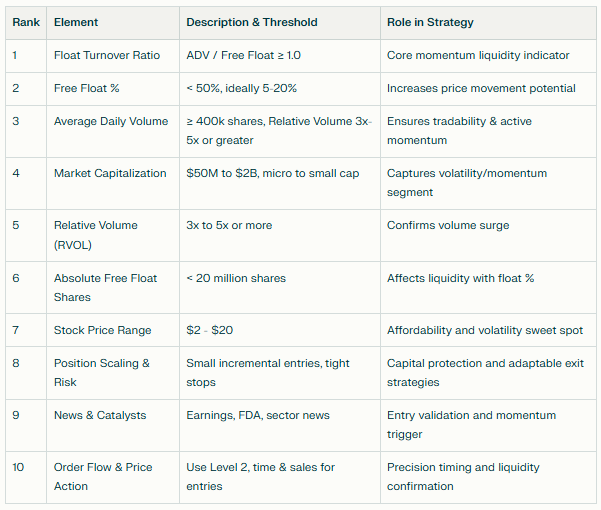
Practical Notes Derived From Ross Cameron & Steven Dux
Start with a scan incorporating float %, market cap, price range, and volume filters.
Look for pre-market activity and catalysts to identify candidate stocks.
Assess float turnover using real-time volume vs float shares.
Enter on momentum confirmation with micro pullbacks and level 2 order flow cues.
Use low risk tight stops and scale out profits incrementally.
Monitor relative volume spikes and volume clusters actively throughout trades.
This guide distills proven momentum trading wisdom from two highly successful traders into a cohesive strategy manual for high float turnover trading. Following it improves targeting and execution while managing risks for consistent gains in volatile markets.
This response integrates the best practices and tactical details from Ross Cameron and Steven Dux while preserving foundational float turnover principles.