
Options Trading vs. Leveraged ETFs: Pros, Cons, and Suitability for Different Traders

Options Trading
Pros
Flexibility: Options allow various strategies (buying calls/puts, spreads, covered calls) to profit from upward, downward, or sideways market moves6.
Leverage: Control larger positions with smaller capital outlay, amplifying potential returns6.
Hedging: Options can be used to hedge existing positions, reducing downside risk6.
Defined Risk (in some strategies): Buying options limits loss to the premium paid, unlike owning the underlying asset outright1.
Cons
Complexity: Requires understanding of "Greeks" (delta, theta, etc.), expiration dates, and pricing models3.
Time Decay: Options lose value as expiration approaches, especially out-of-the-money options6.
Potential for Large Losses: Selling options (e.g., naked calls) can expose traders to unlimited losses47.
Volatility Sensitivity: Options prices are highly sensitive to volatility changes, which can be unpredictable6.
Best For
Experienced traders who understand options mechanics and risk management.
Active traders seeking leverage and flexibility in various market conditions.
Investors wanting to hedge or generate income with defined risk strategies.
Worst For
Beginners without sufficient knowledge of options.
Long-term investors due to time decay and complexity.
Those with low risk tolerance for potentially large or rapid losses.
Leveraged ETFs
Pros
Leverage Exposure: Provide amplified daily returns (e.g., 2x or 3x the underlying index movement)68.
Ease of Access: Traded like regular ETFs on exchanges, no margin account needed6.
Diverse Assets: Available across many sectors and indices, including inverse exposure to profit from declines810.
Short-term Trading Tool: Useful for traders with strong conviction on short-term market moves8.
Cons
Not Suitable for Long-term Holding: Daily reset and compounding effects cause tracking errors over time, leading to divergence from the underlying index68.
Higher Fees: Expense ratios are generally higher than non-leveraged ETFs8.
Amplified Losses: Leverage magnifies losses as well as gains, potentially leading to rapid capital erosion810.
Liquidity Issues: Some specialized leveraged ETFs have low trading volume, making entry/exit difficult8.
Best For
Short-term traders/speculators who want leveraged exposure without margin.
Traders with strong directional conviction on a market or sector over a brief period.
Those seeking to hedge or gain inverse exposure quickly.
Worst For
Long-term investors due to decay and tracking error.
Risk-averse investors who cannot tolerate amplified volatility and losses.
Investors unfamiliar with leverage mechanics and risks.
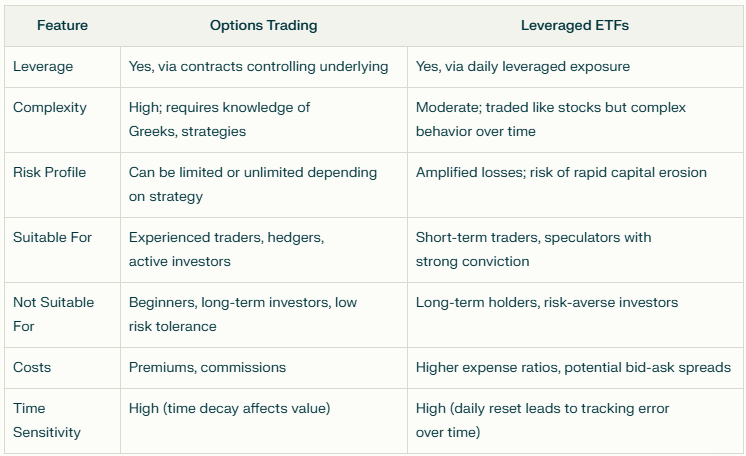
Summary Table
Conclusion
Options trading offers versatile strategies and leverage but demands advanced knowledge and risk management, making it best for experienced, active traders or investors seeking hedging tools.
Leveraged ETFs provide straightforward leveraged exposure suitable for short-term speculation but carry risks of amplified losses and are generally unsuitable for long-term holding or conservative investors.
Choosing between them depends on the trader’s experience, risk tolerance, investment horizon, and market outlook.